THANK YOU FOR SUBSCRIBING
× 
Enterprise Security Mag Weekly Brief
Be first to read the latest tech news, Industry Leader's Insights, and CIO interviews of medium and large enterprises exclusively from Enterprise Security Mag
Enterprise Security Magazine

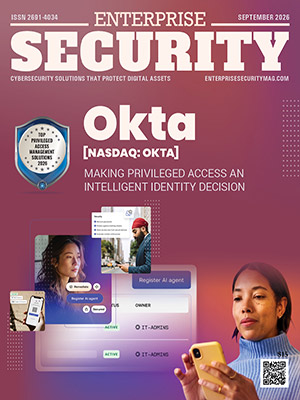
Okta [NASDAQ: OKTA]
Making Privileged Access an Intelligent Identity Decision

Privileged access provides a pathway to highly sensitive systems within a company. An administrator needs to be able to connect to the cloud, databases, servers and applications. As a result, this access is vulnerable to attacks.
Okta’s approach treats privileged access as an identity control rather than a separate infrastructure function. Okta Privileged Access connects elevated permissions with authentication, governance, credential protection and policy controls. Access can therefore be tied to a specific identity, resource and period instead of remaining permanently available.
From Standing Access to Controlled Access
Okta Privileged Access is part of Okta Workforce Identity Cloud, bringing privileged infrastructure access, account management, secrets protection and governance into an identity-centered environment. Instead of forcing administrators to move between disconnected control centers, Okta places privileged access within the same framework used to manage workforce access.
An organization may provide access based on the specific job requirements of the user as opposed to having broad administrative privileges available for a long time. As far as access to servers is concerned, Okta may create accounts on demand and provide temporary access based on defined policies.
This approach helps balance a common challenge in PAM. Security teams need tighter controls over privileged access, while administrators need to get into critical systems quickly when incidents arise or systems need attention.
Credential protection is another part of that equation. Okta Privileged Access includes a Secrets Vault for passwords, API tokens, encryption keys and other sensitive information. Authorized users can access shared secrets while organizations control retrieval and maintain a clearer governance trail.
Using Access Requests, companies can mandate that there be business justification, approval and authorization within a certain period of time before users gain access to secured resources. Privileged access no longer remains an informal understanding between administrators.
This approach is especially relevant in distributed environments containing cloud resources, on-premises servers, databases, applications and service accounts. An identity-centered framework gives security teams a consistent basis for applying privilege rules across those systems.
From PAM Tool to Identity Strategy
Okta’s wider strategy becomes clearer when Privileged Access is viewed alongside single sign-on, multifactor authentication, lifecycle management, identity governance and identity threat protection. Privileged access becomes another control point within the identity architecture rather than an isolated product with its own operating model.
Okta’s broader approach to privileged access has also shaped the evolution of its product offerings. From May 1, 2026, Okta discontinued sales and renewals of Advanced Server Access, replacing it with Okta Privileged Access. According to Okta, the newer solution builds on server access capabilities by adding privileged account vaulting and secrets management to provide a broader PAM offering.
The transition reflects a broader governance objective. Server access remains critical, but privileged accounts, secrets, service accounts and infrastructure identities all require consistent controls over who can access them, what they can reach, how long access remains active and whether that activity can be verified.

Okta’s approach treats privileged access as an identity control rather than a separate infrastructure function.

The transition reflects a broader governance objective. Server access remains critical, but privileged accounts, secrets, service accounts and infrastructure identities all require consistent controls over who can access them, what they can reach, how long access remains active and whether that activity can be verified.
Okta’s 2026 product development reflects this broader approach by extending those controls across additional privileged resources. On-demand password rotation for vaulted server accounts entered Early Access in May, while service accounts also became generally available, helping organizations monitor, manage and control privileged service accounts.
Database PAM entered early access during the same period. Okta’s release documentation says the capability can discover database user accounts, rotate and vault credentials and enforce policy-based multifactor authentication or manual approvals. Initial database support includes MySQL and PostgreSQL.
These additions extend privileged access to the resources where sensitive activity occurs. Databases hold valuable information, service accounts can have considerable permissions and secrets can provide access without representing a human user. Managing each category through disconnected controls creates consistency gaps.
The use of APIs and integration with Okta Workflows enables organizations to integrate privileged access within larger IT and security processes. This allows identity policies to become part of repeatable workflows across distributed infrastructure.
From Policy to Daily Execution
The strength of a PAM solution is tested when an administrator needs access to a critical system. In a controlled approach, privileged access does not need to remain permanently available. Access can instead be requested and granted when policy requirements are met.
The same logic applies to shared privileged accounts. Okta Privileged Access can discover and manage account passwords, rotate credentials and store sensitive information in its vault. Multifactor authentication and Access Requests can add further controls.
Service accounts present another challenge in that they are associated with applications or processes and not persons. However, they may still have powerful rights. Okta 2026 materials include service account capabilities and password rotation policies for both service accounts and SaaS accounts.
Database access follows the same pattern. By combining account discovery, credential vaulting, rotation and policy-based controls, Okta applies identity principles to another critical resource category.
Identity Threat Protection adds another layer of context by helping organizations respond when identity or session conditions change. While it is separate from Privileged Access, it shows how PAM can fit into a broader identity security strategy.
For security leaders, the value is consistency. Policies can be established centrally, privileges constrained, credentials protected and activity monitored. Those capabilities become increasingly important as organizations add cloud infrastructure, contractors, service accounts and distributed systems.
Okta’s privileged access strategy focuses on balancing stronger security controls with operational usability. Its capabilities span servers, privileged accounts, secrets, service accounts and databases as part of a broader identity solution. Its significance goes beyond the number of resources involved, focusing instead on making privileged access part of identity management. This integrated approach strengthens Okta’s position in the PAM market.
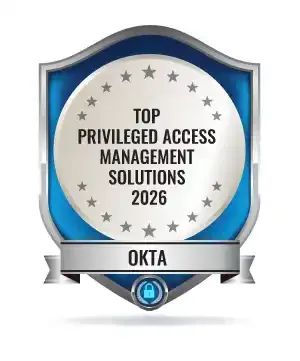
Organizations need to protect critical systems without making legitimate administration unnecessarily difficult. Okta’s approach places that tension at the center of its privileged access model, using identity, policy and automation to make control part of the work rather than something outside it. This identity-centered approach has earned Okta recognition as one of the Top Privileged Access Management Solutions 2026.
Company
Okta [NASDAQ: OKTA]
Management
Todd McKinnon, CEO and co-founder
Description
Founded in 2009, Okta provides cloud-based identity and access management solutions that help organizations securely connect employees, customers, partners and technology. Its offerings span authentication, authorization, workforce and customer identity, lifecycle management, privileged access and identity security across cloud, applications and infrastructure.